
Search All Site Content
Total Index: 6332 publications.
Subscribe to our Mailing List!
Sign up for our mailing list to keep up to date on all the latest developments.
The Peninsula
Do English-Teacher Cuts in Korea Signal a Sea Change?
Published February 21, 2012
Category: South Korea
By Ben Hancock
In the face of budget cuts, the education offices of South Korea’s two most populous regions announced in the second half of last year plans to reduce their roster of native English-speaking teachers in coming years. While the scale of the cutbacks in Seoul and the surrounding Gyeonggi Province is still unclear, the steps raise questions about whether the country as a whole is beginning to move away from an educational model that has exposed millions of Koreans to Westerners and their culture, and vice versa.
What seems to be happening is that Korean education officials are now shifting toward a quality over quantity approach to English education, according to Pak Soon-Yong, a professor of education at Yonsei University. “There is a discussion on the need to revamp English education to meet the needs of the times, one of which is to reestablish the guidelines to accommodate qualified native English teachers,” he says.
That’s a natural shift for Korea to make as a rising economic power with increasing international exposure, says Ben Glickman, who until recently was CEO of the Vancouver-based Footprints Recruiting company that places teachers in Korea and elsewhere. It also roughly follows the arc of Japan’s English-teaching industry — which rose along with its economy and high-tech sector from the 1980s until the mid-1990s, but then evened out in later years.
“Foreigners in Korea are not the novelty that they were 15 or 20 years ago,” Glickman explains. This means there’s less value in just getting kids exposed to a foreign face, especially in urban areas, and more interest in drawing educators who are specially qualified. Even now, many of the teachers hired through the government-run English Program in Korea (EPIK) are recent graduates who are shoved into classrooms with just a week of training, he says. And they’re earning roughly $40,000 a year, making them a target for local councils eager to ease spending.
Still, that amount is less than Glickman earned when he taught English in Korea over a decade ago. This is where the economics of supply and demand come into play. Glickman notes — and I wrote about two years ago — a rise in the number of Westerners newly seeking jobs in Korea or who planned to keep the ones they had, corresponding with the soured state of the job markets in the U.S., Canada and elsewhere. More applicants for less positions means that Korea can afford to be more choosey.
In a recent interview with the Jeju Weekly, Seoul Metropolitan Office of Education (SMOE) Foreign Education Department Chief Choi Chun Ok underlined the scope of the costs to pay for native English-speaking teachers.
“Foreign English teachers have greatly contributed to the development of English education in Seoul,” Choi told the paper. “However, it is time to reevaluate the cost-effectiveness, considering a huge sum of budget (about 52 billion won, or US$45 million annually). So we are changing our policy from quantity expansion to quality improvement.”
Scope of cutbacks unclear
Part of the reason it’s so difficult to get a handle on how deep the cuts will be is because there have been so many conflicting media reports, as noted by blogger Matt Van Volkenburg, who has run “Gusts of Popular Feeling” from his perch in South Korea since 2005. “I don’t think these moves should be exaggerated,” Van Volkenburg says in an e-mail to me. He notes that while the initially announced budget cuts in Gyeonggi were substantial (though the provincial education authority later seemed to backtrack), the cuts in Seoul were relatively shallow. In the capital, it seems clear that native speaker jobs in high schools will be cut significantly, with lesser cuts in middle and elementary schools.
Glickman is not surprised that it’s been hard to figure out what’s going on behind the scenes, especially in Seoul. Characterizing SMOE as a “notoriously opaque” agency, he recalls an instance in 2008 when the office fired more than a hundred teachers just before they were to begin their jobs. Many of them were already in Korea or on a plane, and the office never gave a clear explanation for its action.
That issue aside, it doesn’t seem like the cuts will have a major effect on Korea’s influence abroad, or the country’s allure. Glickman speculates this may have even been a piece of the calculations in deciding to start rolling back the English teacher positions. With Samsung now a household name and kimchi taco trucks proliferating in Seattle, LA, New York and Washington, it’s probably become apparent to Koreans that they don’t need to rely on English teachers to be cultural ambassadors, he says.
Van Volkenburg partly agrees. “As much as people like to scoff at the ‘Korean Wave,’ I’ve been told by people who work with foreign students studying in Korea that quite a few non-ethnic Korean Western students are attracted to Korea because of their interest in Korean music and dramas, so that will continue to pull more Westerners here.”
“It is too bad, however, that few people have thought about how native speaking teachers could be potential sources of information about the country,” he adds. “In the past, some soldiers and a great many Peace Corps volunteers went on to work in business or academia related to Korea. I’ve only ever seen one article … suggesting that foreign teachers be seen as potential ambassadors. Perhaps as the political winds shift and the 2018 Pyeongchang Winter Olympics approach, this idea might become more popular.”
Ben Hancock is a journalist based in Washington, D.C. He has studied Korean language and culture since 2004, and most recently lived in Korea from 2008 to 2010. The views represented here are his own.
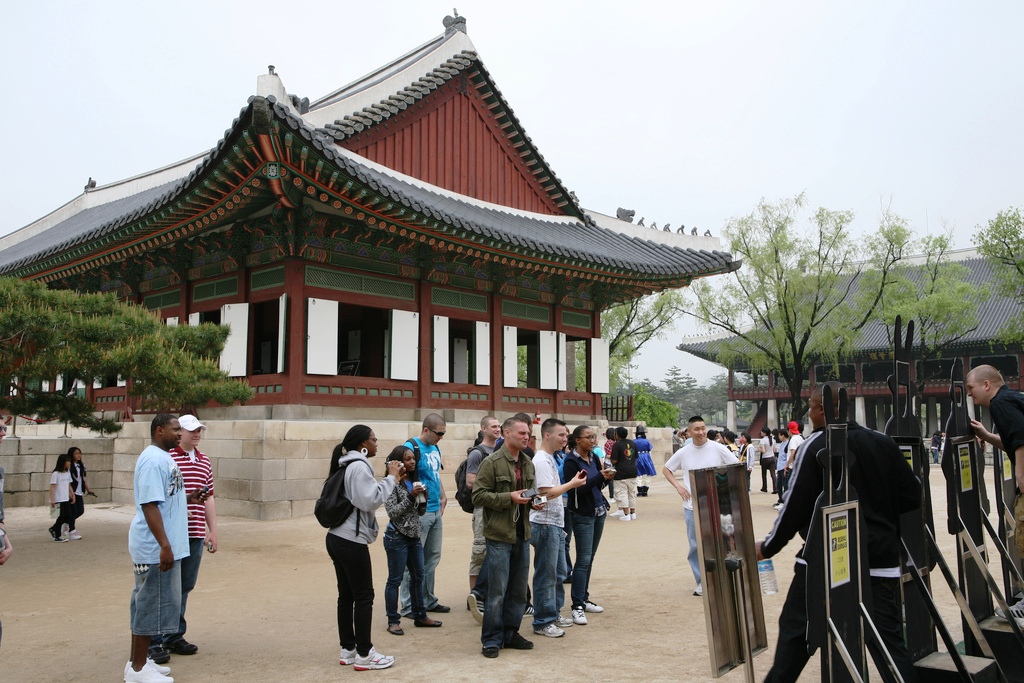
Photo from the U.S. Army Second Infantry Division’s photo stream on flickr Creative Commons.